Water distribution crews
Flushing, main isolation, disinfection, dechlorination, repair documentation, and field record handoff.
Water distribution field software
A mobile-first, installable field companion and municipal operations toolkit for hydrant flushing, flow testing, main volume calculations, disinfection support, meter work, tie-card scanning, VueWorks-ready handoff, and technician reference guides.
Controlled access
The field app and focused flow-test app are installable phone apps available only through the controlled testing process. The full field app also has a controlled Android APK build for approved sideload field testing. The municipal portal remains a controlled-access web surface.
Installable phone app and Android APK build with offline-ready calculators, field log, reports, map, document scanner, barcode scanner, reference library, and configurable cloud record sync.
Standalone flow testing Request flow-test accessInstallable flow-test phone app with GPS capture, checklist, searchable log, CSV export, printable summary, and offline-ready field use.
Municipal web portal Request portal accessOffice-facing asset map, work orders, dispatch, imports, review queue, cloud record sync, reports, and portal buildout views.
Built around field reality
HydrantLoop is a field companion app built to help workers handle common water distribution tasks from a phone. It focuses on fast entry, practical outputs, documentation, and manufacturer-aware reference material while keeping final verification with approved SOP, GIS, engineering review, and manufacturer specifications.
Built by field experience
HydrantLoop is being built from the practical problems that come up when a worker is away from a desk and needs useful information quickly: field calculations, repair references, documentation, photos, scanned tie cards, and clear handoff notes.
The goal is not to replace training, supervision, engineering review, GIS, or manufacturer documentation. The goal is to give field workers a cleaner way to organize the work they already do and bring important reference material closer to the jobsite.
Who it is for
HydrantLoop is being shaped with field use in mind: quick calculations, clean documentation, source-aware reference material, and less back-and-forth when a worker is standing at a hydrant, valve, meter, bypass, or repair site.
Flushing, main isolation, disinfection, dechlorination, repair documentation, and field record handoff.
Flow testing, hydrant repair references, parts lookup, manufacturer-oriented guides, and photo-backed notes.
Meter change-out notes, read comparisons, multiplier checks, endpoint details, and service documentation.
Field observations, testing support, PDF-ready document scans, and cleaner communication back to office systems.
Three app surfaces
HydrantLoop now has multiple surfaces: the full phone app for field technicians, a lighter standalone flow-test workflow, and a web portal for office-facing municipal asset, work-order, review, sync, and reporting operations.
Best for municipal water departments, distribution crews, meter techs, inspectors, and teams that want the full set of calculators, logs, reports, tie-card scanning, and reference guides.
Best for companies that mainly perform hydrant flow tests and do not need the full water distribution toolkit.
Best for supervisors, office users, public works teams, and municipal reviewers who need a broader asset, work-order, service-request, and reporting view.
Web portal
The HydrantLoop web portal is the broader municipal operations surface: asset map, work orders, dispatch, service requests, inspections, programs, compliance, records, planning, inventory, admin settings, workflow rules, imports, public requests, supervisor review, configurable cloud record sync, enterprise suite, buildout tracking, mobile field mode, reports, field-package import, and phone assignment export.
Feature walkthrough
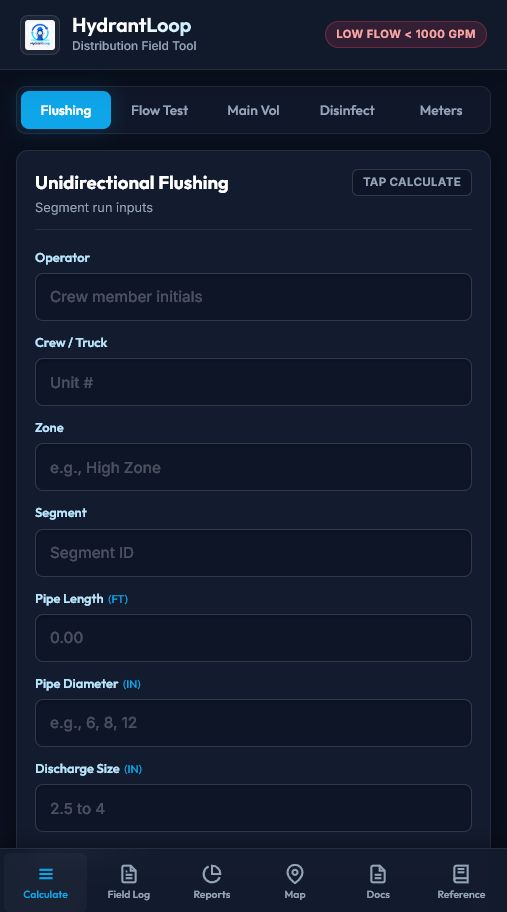
Enter pipe length, diameter, discharge size, pitot pressure, and flush duration. HydrantLoop estimates GPM, main velocity, pipe section volume, water changes, and total discharged gallons.
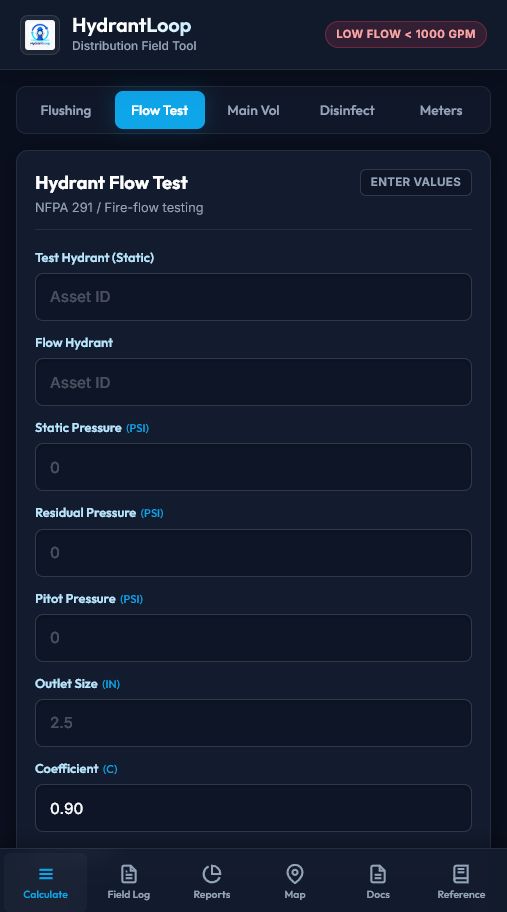
Supports hydrant flow-test inputs with pitot pressure driving observed flow. Static, residual, and target residual can still be recorded for a complete test record and available-flow extrapolation when valid.
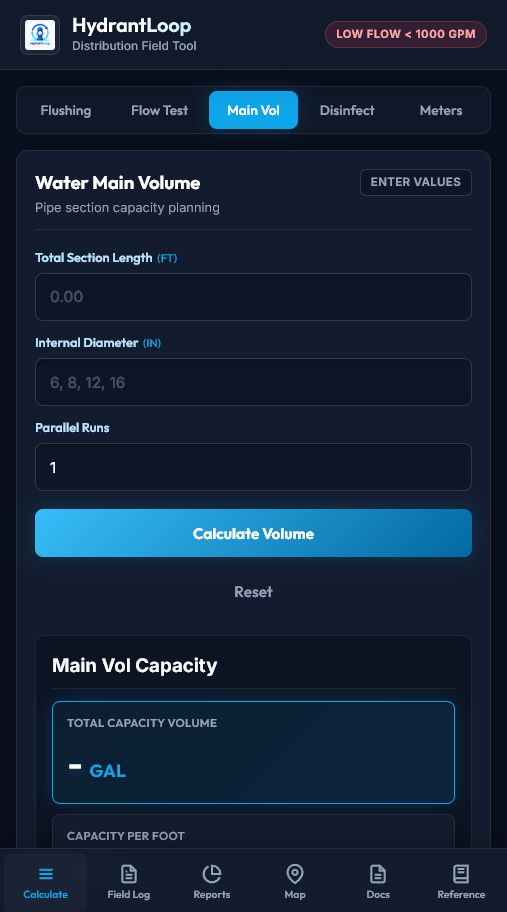
Calculates water volume for a pipe section from diameter and length, giving gallons, gallons per foot, cubic feet, and million gallons.
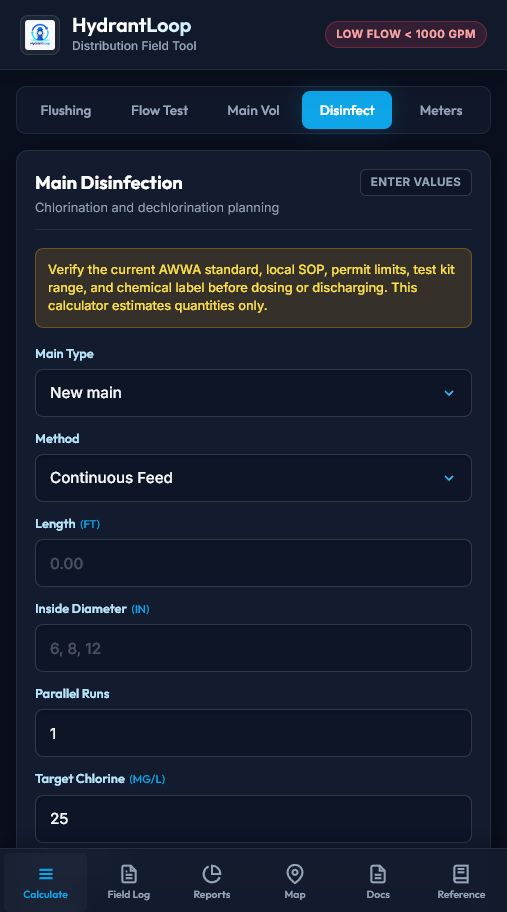
Estimates chlorination and dechlorination values for water main work while keeping safety warnings and verification language visible.
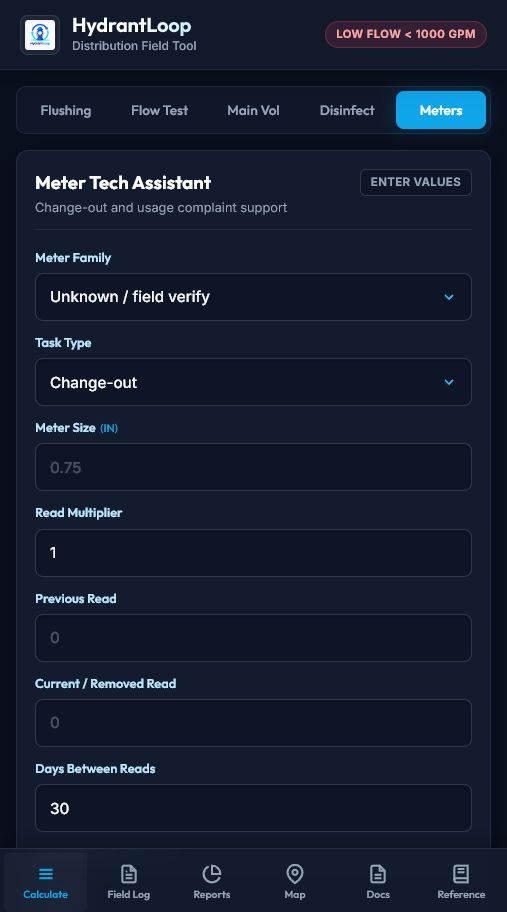
Helps meter techs document change-outs, compare reads, handle multipliers, and review usage patterns from field-entered values.
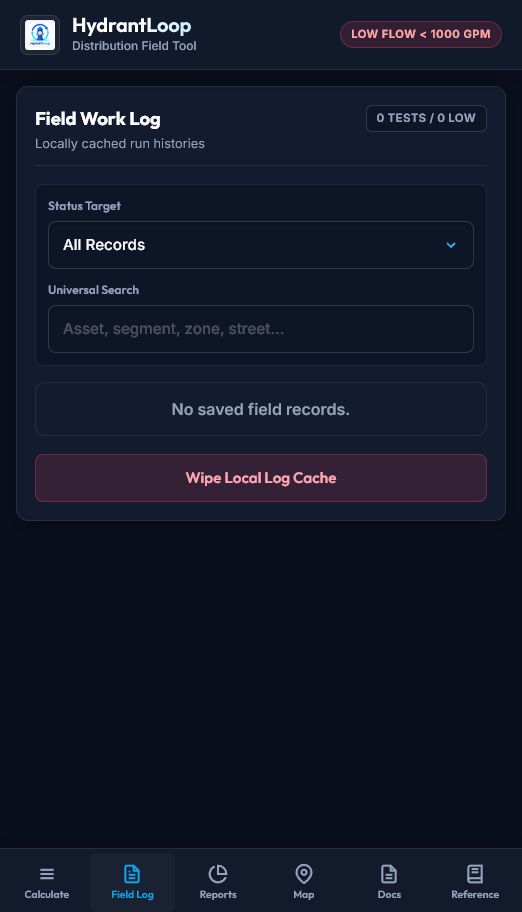
Saves field entries from calculations and inspections so work can be reviewed, filtered, exported, and included in daily reporting.
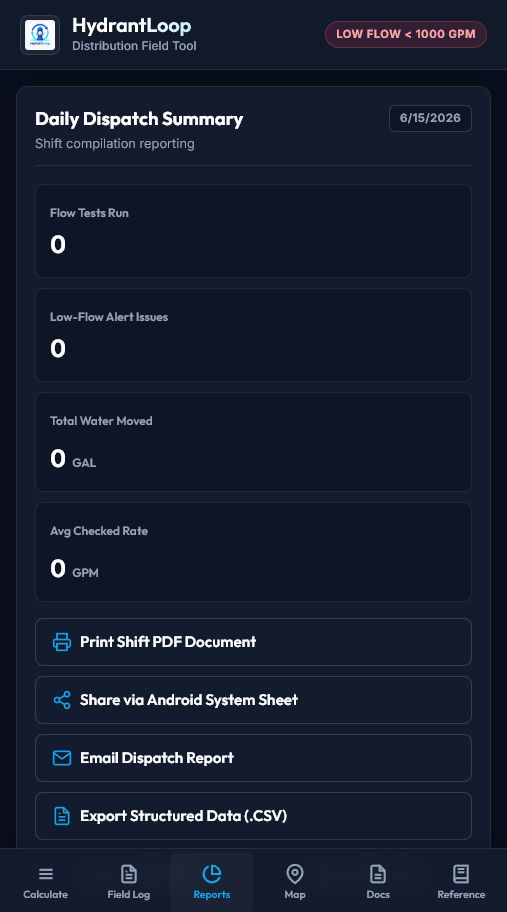
Summarizes field records and provides export, share, email, print, backup, VueWorks-ready handoff, and portal field-package actions for moving data out of the app.
When a municipality provides an approved Supabase project and user account, the field app and web portal can sign in to the same cloud layer, push local records, pull newer records, and log sync activity.
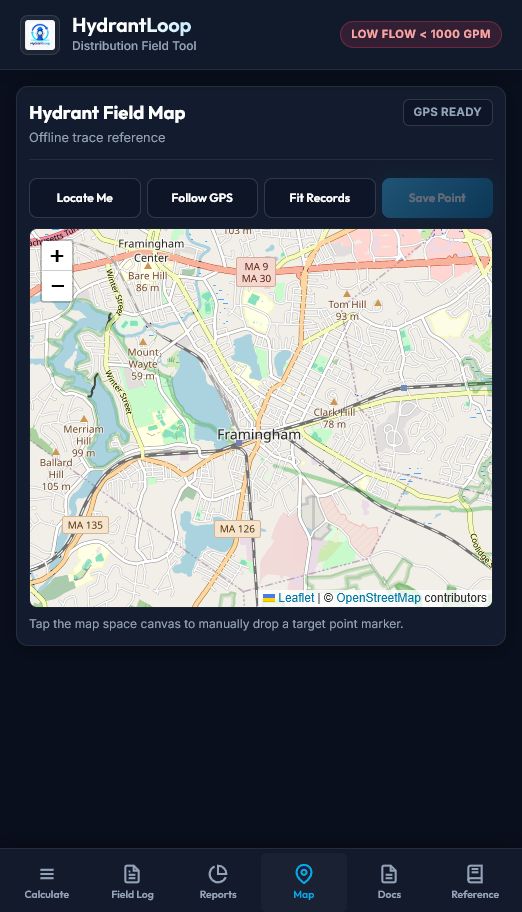
Provides a field map surface for location checks, GPS follow mode, manually staged points, and saved field record positioning using Leaflet/OpenStreetMap assets in the app bundle.
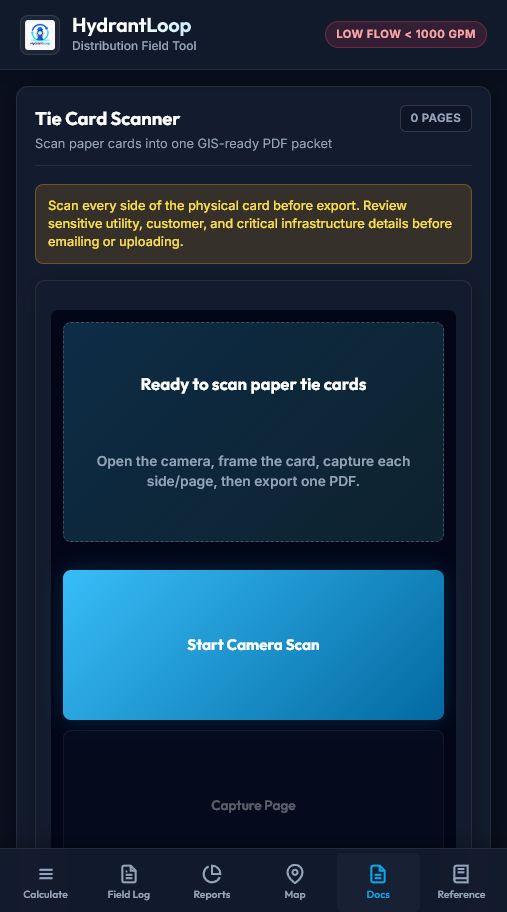
Captures standard water service and sewer service tie-card faces, continuation pages, or other field documents into PDF or TIFF output that can be shared, downloaded, emailed, or uploaded into systems such as Drive, VueWorks, or GIS attachment workflows.
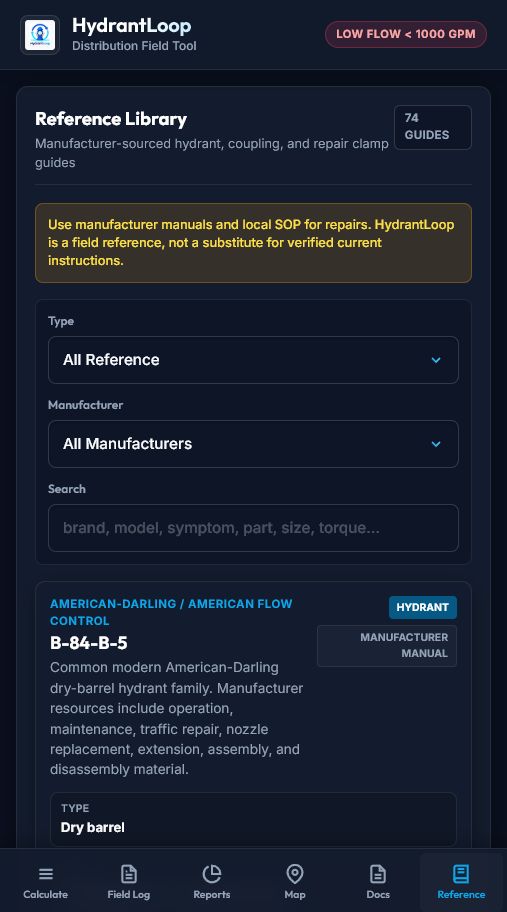
Organizes manufacturer-oriented hydrant, coupling, repair clamp, meter, disinfection, and repair information into a searchable field reference surface.
Adds a larger-screen operations layer for supervisors and office users who need mapped assets, work queues, public requests, phone package imports, assignments, review queues, workflow rules, configurable cloud sync, mobile field mode, Excel exports, printable packets, QR labels, and reporting outside the phone workflow.
No matching features found.
Outside testing
Outside testers should complete the NDA, keep links and screenshots private, avoid unauthorized municipal or customer data, and report usability issues from real phone conditions.
Send NDA and tester instructions.
Open the field test link on a phone.
Test calculators, logs, map, scanner, and reference guides.
Return screenshots, workflow notes, and high-priority issues.
Roadmap
HydrantLoop is being developed in stages so core field value can be tested before larger system integrations are added.
Calculators, field logs, reports, tie-card/document scanning, hydrant and fitting references, meter tech support, and mobile-first workflows.
More complete hydrant repair guides, parts lookup, coupling and clamp cross-reference support, torque/specification reminders, and source-aware warnings.
CSV exports, backup files, scanned PDFs, GPS records, VueWorks-ready handoff packages, and portal field packages for office review and attachment workflows.
Municipal dashboard, work orders, dispatch, service requests, inspections, asset map, records, HydrantLoop package import, supervisor review queue, phone assignment export, configurable cloud record sync, QR labels, Excel export, work packets, attachment vault, manufacturer PDFs, and reporting workflows.
Mobile-first
Designed around phone use in the field.PDF-ready
Multi-page water/sewer tie-card export to PDF or TIFF.Reference-aware
Manufacturer-oriented repair and fitting guides.Portal-ready
Office review, work-order, and VueWorks-style handoff direction.Professional use
HydrantLoop is designed to support field decisions and documentation. Final work should always be verified against current municipal SOP, approved engineering direction, manufacturer documentation, product labels, permits, safety rules, and official GIS or asset records.
Hydrant, coupling, clamp, meter, chemical, and fitting information should be checked against current manufacturer literature before field use.
Testers should avoid entering restricted customer, municipal, or security-sensitive information unless their organization has approved that workflow.
During outside testing, users should avoid real customer account information, sensitive infrastructure details, and internal records unless their organization has authorized that use.
HydrantLoop is a companion tool. It does not replace trained personnel, supervisor direction, confined-space rules, traffic control, water quality procedures, or site safety requirements.
FAQ
HydrantLoop is a mobile field companion for water distribution work, combining calculators, logs, reports, document scanning, mapping support, meter tools, and repair/reference guides.
The current testing group is intended for water distribution workers, hydrant technicians, meter technicians, fire protection testers, inspectors, contractors, and supervisors with field experience.
Yes. Outside testers are asked to sign an NDA before receiving the live testing link or private testing instructions.
Yes. The app is designed mobile-first so it can be used from a phone in the field, including calculator entry, reference lookup, logs, reports, and camera-based document scanning.
The portal is a larger-screen municipal operations surface for mapped assets, work orders, dispatch, requests, inspections, imports, review queue, offline checklist, configurable cloud record sync, reporting, field-package intake, asset history review, QR labels, Excel-compatible exports, printable work packets, attachment vault records, manufacturer PDF records, and phone assignment export. It is separate from the phone-first field app.
HydrantLoop currently supports VueWorks-ready handoff exports. True API integration would require VueWorks documentation, credentials, approved schemas, and municipal IT or GIS approval.
No. HydrantLoop supports field work, but users must verify final actions with their approved procedures, current manufacturer specifications, permits, and official records.
Yes. The purpose of outside testing is to learn what works in real field conditions, what is confusing, and what tools would make the app more useful for crews.
Contact
For testing access, feedback, field-review participation, or questions about the NDA process, contact the owner and creator.